
Notables Tour
〰️
Notables Tour 〰️
Alta Belle Hopkins
Alta Belle Hopkins, born in 1875 in Davenport , Iowa, was the eldest daughter of Edmund Theodore Hopkins and Lynde Enos Hopkins. Though her life was tragically brief, ending at just 23 years of age in 1898, her story is part of a distinguished American lineage and a family remembered not only for their accomplishments but for their enduring cultural legacy — immortalized in the striking monument that marks their resting place.
Alta’s father, Edmund T. Hopkins, was a man of exceptional drive and historical significance. Born in 1838 in New York State, he was a direct descendant of Stephen Hopkins, the Royal Governor of the Colony of Rhode Island and one of the signers of the Declaration of Independence. A Civil War veteran, Edmund pursued a legal education following the war and went on to secure a charter for the Southern Life Insurance Company, an organization notably presided over by Jefferson Davis, the former president of the Confederacy.
Hopkins was involved in a wide range of entrepreneurial endeavors. He became a part-owner of the Homestake Gold Mine in South Dakota — later wholly acquired by William Randolph Hearst — and later joined the J.H. Bass Iron Company in Fort Wayne , Indiana, then the world’s largest manufacturer of steel wheels. Despite his business commitments, he maintained a deep love of nature and hospitality, owning and operating the Lakeview Hotel at Devil’s Lake, a place where the Hopkins family spent many idyllic summers
Edmund was married twice. His first wife and their child tragically passed away in Louisville , Kentucky. He later married Lynde Enos, originally from Michigan. Together, they had two daughters: Alta Belle, born in 1875, and Jessie Lynde, born in 1876. Both sisters were musically gifted, but Jessie, in particular, became known for her extraordinary contralto voice. Alta frequently accompanied her sister on piano during her performances, and their home life was filled with music, refinement, and the joys of summer retreats at Devil’s Lake.
Unfortunately, Alta inherited a heart condition and passed away at Devil’s Lake in
1898. She was the first member of the Hopkins family to be buried in the family plot.
The family continued to experience both achievement and loss. In 1917, while en route by train to Florida, Lynde Enos Hopkins passed away suddenly, her heart giving out during the journey. Edmund Theodore Hopkins died in 1924 at the age of 86, having witnessed the rise of the railroads, the Civil War, and the dawn of the modern era.
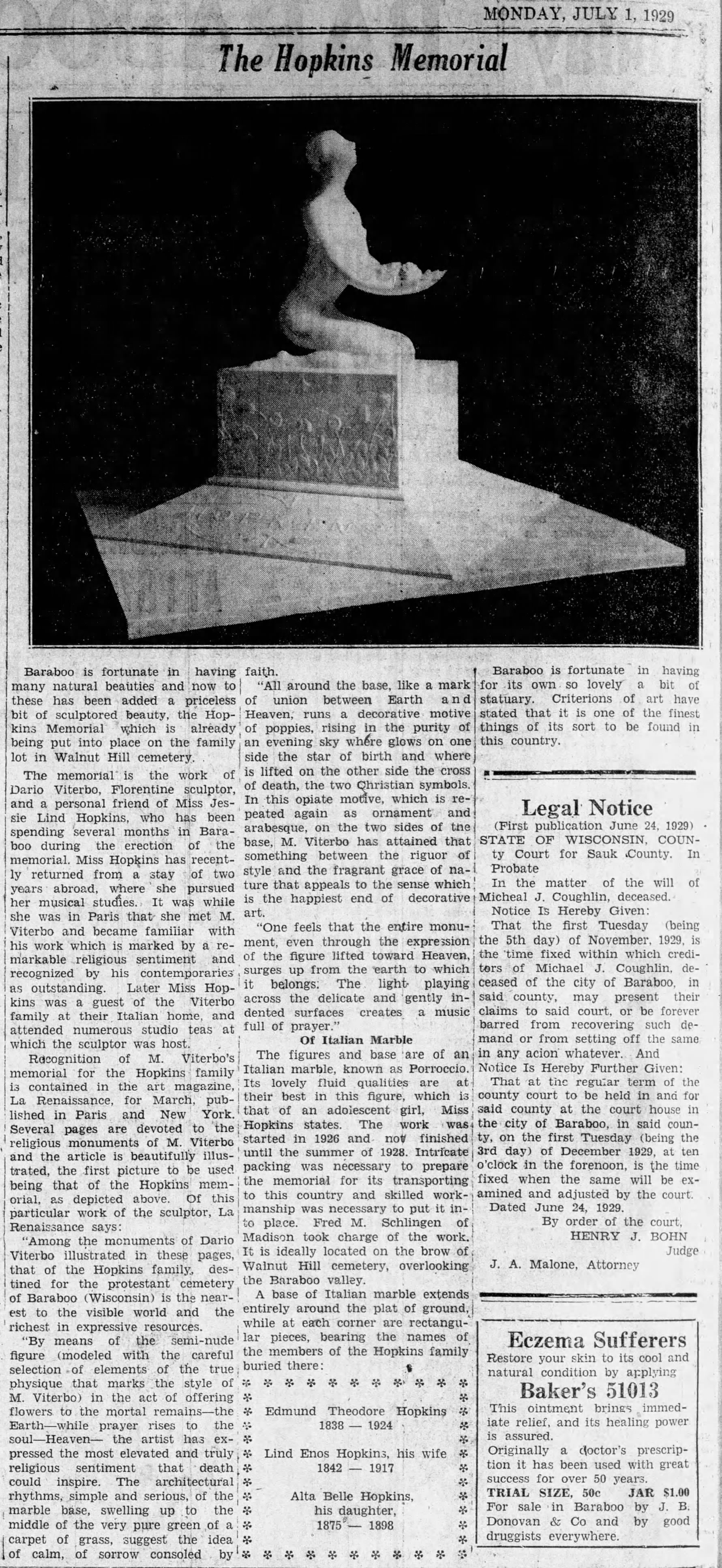
The surviving daughter, Jessie Lynde Hopkins, flourished as a professional singer. She performed with major orchestras in Pittsburgh, New York, Milwaukee, and Saint Paul, and also spent two years studying music in Europe. While in Paris, Jessie met the renowned Italian sculptor Dario Viterbo, forming a lasting friendship. Viterbo would later create a custom sculpture for the Hopkins family memorial — a bronze figure offering flowers to the mortal while prayer rises toward heaven.
The sculpture is rich in symbolism: poppies encircle the base, uniting earth and heaven, while the star of birth and the cross of death mark opposing sides of the monument. It remains one of the most striking and meaningful memorials in the cemetery.
Jessie Lynde Hopkins passed away in 1963, becoming the final member of the Hopkins family to be laid to rest in the family plot. The monument, commissioned by Jessie and crafted by a master of European sculpture, serves not only as a grave marker but as an enduring artistic and emotional tribute to a family steeped in history, music, resilience, and remembrance.
Biographical information provided by the Sauk County Historical Society.
Baraboo News Republic ~ July 1, 1929
Andrew Andrews
Andrew Andrews was born in Ledbury, Herefordshire, England — a fact that, as he once said, could be easily deduced from both his name and his headstone. In his youth, he learned the traditional craft of shoemaking, which in his day was truly an art form. Every pair of shoes he produced was made entirely by hand, a reflection of skill and care passed down through generations.
In 1839, Andrews married Lydia Gotheridge. The couple had several children in England, though not all survived infancy. By the time they left for the United States, only two children remained. The family that crossed the Atlantic in search of a better life consisted of Andrew, Lydia, their two surviving children, and Andrew’s younger brother Samuel. They eventually settled in Baraboo , Wisconsin, around 1850, during a time when the town was still developing from a rustic frontier village into a thriving community.
Andrews quickly established himself as the town’s shoemaker. In a place where tradesmen were essential to daily life, his craftsmanship met an important need and earned him both respect and a stable livelihood. He saw in America not only a new landscape but an opportunity — a place where a man could build something for himself and for his family.
His personal life, however, was marked by profound loss. In 1853, his daughter Mary Ann passed away, followed by his wife Lydia in 1854. A year later, their last child, little John, also died. The entire family that had accompanied him from England was gone within the span of three years. Devastated, Andrews immersed himself even more deeply in his work. Shoemaking became not just his trade, but a refuge from sorrow.
Though known for his reserved demeanor and stoic character — some described him as " stodgy " — he had a surprising and heartwarming tradition. Every Christmas, Andrews would rent the finest four-horse sleigh team available, decorate the sleigh with festive trimmings, and fill it with delighted local children for a holiday ride through the countryside. With the sound of sleigh bells ringing, he created moments of joy that lingered in memory long after the season passed.
In 1867, as Baraboo was officially incorporated as a village, Andrews became one of its first elected trustees. He served on the Village Board for several years, contributing to the civic development of the growing town.
Eventually, Andrews remarried. His second wife, Mary Ann Mould, was only 15 years old at the time of their marriage, while he was 49. It is possible that Mary had previously served as a domestic worker in the Andrews household, a common role for young women of her age in the mid-19th century. Together, they had one son, Andrew Andrews Jr., named in his father's honor.
After nearly three decades in the shoemaking trade, Andrews retired and moved to a small farm just south of town, intending to spend his remaining years in quietude. But his life came to a sudden and tragic end. One day, after returning from town, he attempted to draw water for his horse from a cistern. It is believed that his hat fell in, and while attempting to retrieve it with a pole, Andrews lost his footing and fell into the cistern, where he drowned. He was 66 years old.
Following Andrews’ death, Mary Ann Mould Andrews, then only 32 years old, never remarried. She lived with her mother and raised her son, Andrew Jr., to adulthood. Mary lived an extraordinarily long life, reaching nearly 98 years of age, and died in 1946. Her lifetime spanned nearly the entire history of modern Wisconsin, from its founding as a state in 1848 through the Civil War, two World Wars, and the Great Depression. She is buried elsewhere in the cemetery, alongside her son and daughter-in-law.
Today, Andrew Andrews is remembered not only as Baraboo’s early shoemaker and civic leader, but as a man who endured great personal tragedy while continuing to give back to his community with quiet resilience. His name lives on in the local history of Baraboo — etched in stone, and echoed in every pair of shoes and every sound of jingle bells that recall his holiday tradition.
Biographical information was provided by the Sauk County Historical Society.
Archibald Barker
Archibald Barker was born in 1816 in the verdant hills of Ireland, the son of Protestant parents, Thomas and Rebecca Barker. Raised in a respectable household, young Archibald was imbued with a sense of independence and adventure early in life. At the age of eighteen, he set out alone for America, embarking on a six-week voyage that would deliver him to New York City — a metropolis of over 250,000 people and the largest city he had ever seen.
But New York was only the beginning. Driven by curiosity and opportunity, Barker gradually made his way west to the Wisconsin Territory, where he found work in the lead-mining region of the southwest. There, he met fellow Irishmen Andy Dunn and Hugh McFarlane, along with Henry Dodge Jr., son of the territorial governor. It was Dodge who informed them of a new treaty signed in late 1837 with the Ho-Chunk ( Winnebago ) Nation, opening lands west of the Wisconsin River to white settlement.
With this knowledge in hand, Barker and his companions ventured toward the Baraboo Valley, where they found a promising tract of land — once an Indigenous cornfield — and began building a cabin. But before construction was complete, they were met by Native inhabitants who dismantled their structure. Undeterred, Barker and a small group tried again, this time near Fort Winnebago at Portage, constructing a shared winter cabin. Yet again, conflict arose. In December, Native residents set a grass fire to drive them out. As flames engulfed the cabin, the men escaped to the Wisconsin River, where they used long planks to cautiously cross the newly frozen surface, crawling across while praying the ice would hold. They reached Walsworth’s trading post, battered but alive.
Following these tumultuous experiences, Barker transitioned into the logging industry, cutting and floating logs down the Baraboo River and into the Wisconsin. In the spring of 1841, he encountered one of the most remarkable sights of his life: a living “ dam ” of sturgeon at the rapids so dense and massive they resembled a stone barrier. Entering the water, he was knocked over by the sheer weight and force of the fish.
That winter, Barker suffered severe frostbite, resulting in the loss of all the toes on his right foot — a consequence of life on the frontier. But hardship never slowed him down. Hearing of the California Gold Rush, he traveled west to mine. Though he found gold, his mining partner made off with more than his share. When Barker confronted him and demanded proof of his innocence, the man stripped naked to prove he had nothing hidden — and then promptly fled to Australia. Barker, undeterred and intrigued, followed him across the globe.
With a brother living in Australia, Barker spent over a year mining during that country’s gold rush. Afterward, moved by a desire to see his aging parents again, he made the arduous three-month voyage back to Ireland. After one final visit home, he set out for America once more — this time stopping in England to purchase $4,000 in dry goods to resell in the United States.
His return trip in 1854 was aboard the “ City of Philadelphia, ” a new iron-clad steamship making its maiden voyage. Steamship travel was still in its infancy, and only months earlier, its sister ship, the “ City of Glasgow, ” had mysteriously vanished at sea. Barker's ship, too, met trouble — it struck a rock off the coast of Newfoundland. Due to the ship's magnetic compass being thrown off by its iron hull, it had gone off course. Fortunately, the captain managed to beach the vessel, and all 600 passengers survived. Barker, however, lost all his merchandise in the wreck.
Back in Wisconsin, he checked on land he had purchased near Baraboo and later moved south to the Mississippi River, where he bought and sold grain and livestock. During this time, he met Sarah Jane Lamborn, whom he married. The couple returned to Baraboo and built a successful dairy farm, eventually raising seven sons and a daughter. Their enterprise became one of the area's leading butter producers, which Barker would often describe as the true gold of his life.
As he aged, Barker witnessed Baraboo transform from wilderness into a thriving town. He and Sarah moved into one of the city’s grandest homes — built near the very place where he had first tried, decades earlier, to raise a simple cabin. Barker passed away in his later years, having lived a life of adventure, resilience, and enterprise.
Legacy of a Global Voyager
By the end of his life, Archibald Barker had circumnavigated the globe, spending an estimated eight months at sea. His experiences as a miner, lumberjack, gold prospector, homesteader, and dairyman reflected not only the spirit of early American pioneers but also the restless drive of an Irishman in search of fortune and freedom.
Barker’s life was marked by peril and perseverance, and his memory is steeped in the lore of Sauk County. His gravestone — and his journey — stand as a testament to the hard-earned progress of the 19th-century American frontier.
Biographical information provided by the Sauk County Historical Society.
Burritt Clarkson Cochran
Burritt Clarkson Cochran was born in 1846 in Burlington , Wisconsin, into a deeply principled and devout family. His names were chosen with care and purpose: Burritt in honor of Elihu Burritt, the blacksmith-turned-diplomat known for his humanitarianism, and Clarkson after Thomas Clarkson, the English abolitionist and pacifist. His surname, Cochran, came from his father, the Reverend Warren Cochran, a Congregationalist minister whose convictions shaped every aspect of the family’s life. Burritt's mother, Caroline, shared her husband’s moral vision and together they named all seven of their children after figures they admired for their virtue and commitment to causes of moral and spiritual worth.
Burritt grew up especially close to his older brother, Harlan Brainerd Cochran, who had been named after the evangelist Harlan Page and missionary David Brainerd. Born just two years apart, the brothers shared a bond that would last even beyond death.
Shortly after Burritt’s birth, the Cochran family relocated to Prairie du Sac in Sauk County, where Reverend Cochran had already been preaching to the region’s early settlers. Around 1849, they moved again — this time to the newly founded village of Adams, then the county seat. There, Reverend Cochran played a foundational role in organizing the Congregational Church, both spiritually and physically. He not only led the congregation but also helped mold the very bricks used to construct the church building, living his values of simplicity, righteousness, and hard work. Abstaining from all vices, including dancing and drinking, Reverend Cochran preached temperance and moral reform throughout the community.
In 1853, a notable event in Baraboo marked the influence of such preaching: after months of impassioned sermons on temperance, a group of local women — emboldened and determined — raided local saloons and stores, smashing liquor containers and emptying barrels into the streets. It was a dramatic moment in Wisconsin’s early temperance movement, one that delighted Reverend Cochran and surely left an impression on young Burritt.
That same year, Reverend Cochran opened a seminary — a private school — in Baraboo where Burritt and Harlan were among the early students. There, the brothers studied moral philosophy, algebra, and geology. Their academic pursuits, however, were cut short by national strife. The Civil War erupted, and like many of their generation, the Cochran brothers answered the call to serve.
Harlan was the first to enlist, joining the Seventh Michigan Cavalry. He saw action in the Eastern Theater and fought in the aftermath of Gettysburg. In July 1863, during the retreat of Lee’s forces near Falling Waters , West Virginia, Harlan was shot while on horseback. He died a few days later, a casualty of war at just 18 years old.
Grief-stricken but resolute, Burritt followed in his brother’s footsteps, enlisting in January 1864. He joined Company A of the 6th Wisconsin Volunteer Infantry, a unit known for its bravery and sacrifices and part of the famed Iron Brigade. Burritt saw combat in some of the war’s most harrowing battles, including Spotsylvania and Cold Harbor. He survived the war’s final year and marched in the Grand Review of the Armies in Washington, D.C. — a proud moment that marked the Union’s hard-won victory.
Returning to Baraboo in July 1865, Burritt was physically weakened from his service. He suffered from what was then referred to as " congestive chills, " an ailment likely contracted in the Southern climate. Tragically, just weeks after his return, Burritt died shortly before his 19th birthday.
Though Harlan is buried in Maryland, the Cochran family ensured that the brothers would be united in memory. Burritt’s gravestone in Baraboo bears both of their names, a symbol of the closeness they shared in life and in sacrifice.
The Civil War Legacy of the Cochran Brothers
Burritt and Harlan Cochran were among the approximately 1,600 men from Sauk County who served in the Union forces during the Civil War. Of those, 285 died — many not in battle but from disease, exposure, or the lingering effects of war. Harlan died on July 24, 1863, at the age of 18 years, 10 months, and 25 days. Burritt passed almost exactly two years later, leaving behind a legacy of quiet devotion, courage, and unshaken moral resolve.
Their story reflects not only the toll of war on American families, but also the deep moral convictions and reformist spirit that shaped the early settlers of Wisconsin — many of whom, like the Cochrans, lived lives of principle and purpose, and gave them willingly to their country.
John Duckins
John Duckins was born around 1820 in Kentucky, according to the few records and oral histories that survive. His ancestry traced back to Madagascar, and like many African Americans of his time, he was born into slavery. During the 1850s, in an act of courage and determination, Duckins escaped bondage and fled northward. He was part of a group of freedom seekers who traversed through Ohio and Indiana, often pursued and forced to move frequently to evade capture.
Eventually, Duckins found employment on a steamer operating on the Great Lakes. Over time, he managed to save a modest sum and relocated to Wisconsin. In 1856, he purchased forty acres of land near a small village known as Mauston, paying $300 for the property with the intention of building a stable life as a free man.
However, his plans were disrupted in 1861 with the outbreak of the Civil War following the attack on Fort Sumter. His life took a further unexpected turn in 1863 when the federal government issued its second draft call. His name appeared on the list for conscription into the Union Army.
When he reported to Prairie du Chien to enlist, Duckins was denied entry into the military due to his race. Despite being barred from serving, he was still obligated to pay the $300 commutation fee — an amount legally allowed for men who chose not to serve. This injustice weighed heavily on him. To meet the fee, Duckins was forced to sell his forty acres at a loss, a decision that also led him to postpone plans for marriage due to his altered financial circumstances.
Following this setback, Duckins moved to Baraboo, where his fortunes gradually began to improve. He received assistance from Colonel James Maxwell and his family, who resided on the town’s south side. The Maxwells, known for their role in the Underground Railroad, reportedly used their large cellar to shelter runaway slaves seeking freedom in Canada.
With the support of the community, Duckins established a small but beloved business. Using two ponies and a buckboard wagon, he began offering scenic rides to local attractions such as Devil’s Lake and the Dells. He was known not only for his kind spirit but also for his joyful nature; he often sang while driving his wagon through town and played the piano whenever he had the opportunity.
Duckins remained in Baraboo for the rest of his life. He passed away in 1894. Some years later, a gravestone was erected in his honor by Julia Crouch, in recognition of the warm memories he left behind.
John Duckins’ story is interwoven with the broader narrative of African American resilience, the abolitionist movement, and Wisconsin’s quiet but critical role in the fight against slavery. Though many details of the Underground Railroad in Wisconsin remain obscured due to its necessary secrecy, homes like that of the Maxwells in Baraboo played a key role in helping more than 100 enslaved individuals find freedom between 1842 and 1861. Duckins’ life stands as a testament to the power of courage, hope, and dignity in the face of systemic injustice.
Biographical information was provided by the Sauk County Historical Society.
Mary Cowles
Mary Cowles was born in Harpersfield, Ohio, in 1817. In 1843, she married Charles Cowles.
The young couple began their family in Ohio, but Charles, inspired by the westward movement, decided to move west. In the spring of 1846, the Cowles family packed their belongings and journeyed to the emerging settlement of Baraboo in the Wisconsin Territory. At the time, the Baraboo Valley was sparsely populated, consisting of only a few mills, rudimentary dams, and crude homes.
The Cowles family built their first home — a modest cabin — about three miles west of what is now downtown Baraboo, on the road to Portage. There, Dr. Charles Cowles established himself as the first physician in the Baraboo Valley, a region that was sorely in need of medical care. His services extended for many miles in every direction. On one particularly harrowing occasion, he rode 64 miles overnight in -26°F temperatures to attend to an injured lumberjack near the Lemonweir River.
On another occasion, he traveled to Portage to care for a patient, a trip that in those days required an overnight absence. That same night, Mary found herself alone with their baby when a bear entered the cabin. Drawn by the scent of a pot of beans left by the hearth, the bear helped itself, scattering food across the floor. Terrified, Mary lay still until the animal finally left. At the time, their cabin door was nothing more than a blanket — a situation promptly remedied when Charles returned. He was immediately dispatched to Garrison’s mill to commission a proper door, which he installed without delay.
As the years passed, the Cowles family built better quarters and witnessed Baraboo’s steady growth and prosperity. Yet, with that prosperity came new challenges. Saloons and taverns began to spring up throughout the town — one situated just down the street from the courthouse. By 1854, concern over the increasing presence of alcohol in the community reached a tipping point.
In what came to be known as the Baraboo Whiskey War, approximately 50 local women — including Mary Cowles — took direct action. They marched to the Wisconsin House, one of the town’s drinking establishments, and poured its liquor supply into the street. Their aim was symbolic and resolute: they wanted alcohol to " run in the streets, " not in the homes of their neighbors. As the protest reached a third saloon, tensions escalated and a near-riot ensued before the sheriff intervened and read the Riot Act. Mary Cowles was identified as one of the leaders and, along with others, was taken to Sauk City for trial. Though they were fined, the women made their message unmistakably clear.
Mary Cowles lived a long and meaningful life in Baraboo, alongside her husband Charles, and both contributed significantly to the town’s early development. Their legacy is commemorated in a monument that stands to this day. The inscription on the monument reads: "Given to hospitality – she hath done what she could. " A fitting tribute to a woman who faced hardship, danger, and injustice with quiet strength and steadfast purpose.
The Cowles Monument: A Legacy in Zinc
The Cowles family monument in Baraboo is distinctive, both in appearance and material. Unlike traditional stone markers, this memorial is constructed from “ white bronze, ” a trade name for pure zinc. Manufactured by the American White Bronze Company of Chicago, the monument is hollow, cast using a patented process that involved wax forms and plaster molds. Molten zinc was poured into these molds and the pieces were then fused to create a remarkably durable and weather-resistant structure.
Introduced in 1873 and gaining popularity in the following years, white bronze monuments were marketed as more affordable and longer-lasting than traditional stone markers. While many people remained skeptical at the time, modern observers note that these zinc monuments have often outlasted their stone counterparts, weathering to a bluish-gray patina that resists erosion remarkably well.
Today, white bronze monuments are rare, making the Cowles marker both a historical artifact and a testament to the enduring memory of Mary and Charles Cowles — pioneers who helped shape the early identity of Baraboo.
Biographical information was provided by the Sauk County Historical Society.
Joseph Nedimovic
Joseph Nedimovic, known simply as " Joseph " to many in his adopted homeland, was part of a wave of Serbian immigrants who sought opportunity and peace in the early 20th century United States. He emigrated from Serbia around 1910, accompanied by his older brother Nick, Nick’s wife Katie, and Katie’s brother Dan. Serbia, burdened by frequent wars and limited prospects, had little to offer its youth. Like many, the Nedimovic family looked to America for a better future.
The family initially settled in Wisconsin, with Nick taking up various odd jobs on the south side of Baraboo. Katie gave birth to a son, Emil, as the family began establishing roots in the region. Joseph first found work near Shullsburg before rejoining his relatives in Baraboo. Together, they rented an old, quiet farm along the Baraboo River from a widow named Ruhland.
To sustain themselves, the family undertook a variety of work, but the arrival of Prohibition in the 1920s opened a different kind of opportunity. Drawing on a deeply rooted Serbian tradition, Joseph began distilling homemade liquor — moonshine. In his homeland, the production of rakija, a fruit brandy, was a cultural norm — consumed at weddings, funerals, and social gatherings. To Joseph, making alcohol was not a crime but a way of life.
With the onset of Prohibition, Joseph set up a hidden still on the property and began producing moonshine using ingredients such as raisins, cherries, and corn. Raisins, in particular, were inexpensive and yielded a quality mash. As demand grew, especially in rural communities with limited access to alcohol, business flourished. Joseph worked with local contacts such as Byron Stevens, who brought customers directly to the farm. The operation reached its peak during the annual September fair, when townspeople and visitors alike sought out his spirits.
However, the risks of operating outside the law eventually caught up with him. During one particularly busy fair week, a man from Wonewoc purchased a few pints of moonshine for six dollars. He returned later that same day — this time accompanied by two federal agents and a driver named Earl Jaquish. Mistaking them at first for additional customers, Joseph was quickly confronted with a raid. Though he initially denied possessing any alcohol, the agents searched the property and discovered three jugs, which they placed outside. While one agent guarded the jugs, another began searching for the still.
Knowing the still was well hidden, Joseph's concern turned to the exposed evidence and what it might mean for his brother’s family. Anger and desperation overcame him. Grabbing an axe from the woodpile, he smashed the confiscated jugs. Tensions escalated quickly. When an agent tried to stop him, Joseph turned the axe on the man, who responded by firing a warning shot into the air. Undeterred and driven by rage, Joseph continued his assault until the agent fired five more times, striking Joseph and ultimately bringing him down.
Remarkably, Joseph survived the gunfire. After regaining consciousness, he walked back to the house and sat on the steps, perhaps reflecting on how a lifetime of struggle and survival had brought him to this moment. Not long after, he succumbed to his injuries.
Joseph Nedimovic was laid to rest in Baraboo. Though his life ended in tragedy, his brother Nick ensured that he would not be forgotten, erecting a monument in his memory. The stone remains, a quiet testament to an immigrant's resilience, cultural pride, and a complicated chapter in American history.
Prohibition and Moonshine in Sauk County
Joseph Nedimovic was far from alone in producing illegal liquor during Prohibition. Sauk County, like many rural communities, became a hub for moonshiners. In one operation near Reedsburg, moonshine was shipped to Chicago concealed in ten-gallon milk cans. A false bottom held nine gallons of liquor, with a single gallon of milk layered on top to fool inspectors.
During this era, the term moonshiner referred to those who made the illegal liquor, while bootleggers were the individuals who distributed and sold it. The distinction mattered little to federal agents, who aggressively pursued both. Nedimovic’s story reflects both the entrepreneurial spirit and the danger that many immigrants faced while navigating the contradictions of American law and culture during one of its most controversial experiments — Prohibition.
Biographical information provided by the Sauk County Historical Society.
Philip Pointon
Philip Pointon was born in Shelton, in the county of Staffordshire — an area world-renowned for its pottery industry. Philip followed the traditional path, learning the craft from his father. Along his life’s journey, Philip married Miss Ann Joynson. Together, they had seven children, the first of whom — named Philip, after both father and grandfather — would one day carry on the family legacy. In 1850, amid a wave of emigration by skilled English potters seeking better prospects, the Pointon family made the bold decision to journey to America. Encouraged by Major David Twiggs, who had visited England to promote settlement in the Wisconsin Territory, Philip was confident that his experience could lead not just to employment but to ownership of his own pottery works.
After a lengthy and arduous transatlantic voyage, the family arrived at Fort Winnebago — only to find that the most desirable government land had already been claimed. Hearing of a promising new village to the west called Adams, which was poised to become the county seat, Philip set off on foot with his eldest son and daughter to explore the region.
What he discovered in the Baraboo Valley impressed him. Soon, the entire family relocated, purchasing land near the river's edge on the outskirts of the village. Before clay could be fired into pottery, Philip needed to build brick kilns, drying houses, and warehouses. To fund and support this effort, the family began by making bricks — supplying not only others in the region but also producing the very materials used to construct their future pottery.
Eventually, the Baraboo Pottery was born. It specialized in fine earthenware made from clay sourced at Windy Bailey’s farm. The Pointons crafted a variety of goods, from crocks and jugs to spittoons, dishes, and garden pots. While some items were still thrown on the wheel, the family invested in a molding machine to accelerate production. Their signature crocks ranged from two to five gallons in size and were marked with numbers and decorative flourishes to identify them as products of Baraboo.
Business flourished to the point where three wagons were required to deliver pottery to surrounding communities.
Tragically
, Philip Pointon Sr. passed away in March of 1857 at just 49 years old. His passing marked a turning point in the company’s story. Later that year, the Baraboo Pottery was sold and, in November, destroyed by fire. It was never rebuilt.
Philip Pointon's life was brief but impactful. His journey from the potteries of Shelton to the forests of Wisconsin reflected the hope and hardship of countless immigrants. His spirit lives on in every dish, jug, and crock that passed through his hands — and perhaps in the dishes people still put away each day.
Biographical information was provided by the Sauk County Historical Society.
William Berry
William Berry’s monument in the cemetery often draws attention for its unusual and symbolic design — a tree stump representing a life cut short, and a carved locomotive honoring one of his greatest passions.
Berry was born in 1854 in the small northern New York village of Malone, near the Canadian border. Just three years later, another well-known Malone native was born nearby — Almanzo Wilder, who would later marry Laura Ingalls. Though Malone was a quiet village, it had seen its share of excitement. Decades before Berry’s birth, the town had been sacked by the British during the War of 1812. During his boyhood, Berry watched as soldiers of the 98th New York Volunteer Regiment camped on the fairgrounds east of the village before leaving to fight in the Civil War.
What fascinated young William most, however, was the railroad. The Ogdensburg Railroad passed through Malone on its way to Lake Champlain, and the town boasted machine shops and repair yards. The great steam locomotives — belching smoke and hissing clouds of vapor — captured his imagination, and from an early age he dreamed of becoming an engineer. In time, he did just that.
Berry eventually worked for the Chicago and Northwestern Railroad, which brought him west to Baraboo , Wisconsin. The line had only reached Baraboo in the fall of 1871, coming north from Madison through the gap in the bluffs at Devil’s Lake. The Chicago and Northwestern made Baraboo a division point between Chicago and Minneapolis, establishing headquarters offices, repair yards, a roundhouse, and a massive turntable for turning engines — an environment perfectly suited to an ambitious young railroad man.
In 1879, Berry married Alice Bell, the love of his life. Her father, an Englishman, had emigrated to America before her birth. A few years into their marriage, the couple welcomed a son, but tragedy soon struck before the boy could truly know his father.
On July 20, 1884, while taking an engine onto a side track near Mendota, just north of Madison, Berry’s locomotive derailed and tipped over. His fire
man, Charles Young, managed to leap clear, but Berry’s right foot became trapped in the wreckage. Scalded by steam from the ruptured boiler, he realized the severity of his injuries. With his final strength, he tore his watch from his vest and handed it to his rescuers, saying, “ It’s no use, boys; I am too badly burned. Give this watch to my wife, and take care of her and the baby. ” Moments later, he was gone — only thirty years old.
His monument, topped by the carved tree stump and bearing the image of a locomotive, remains a poignant tribute to a life and passion cut tragically short.
Information provided by the Sauk County Historical Society.
Roseline Peck
Roseline Willard Peck was born in 1808 in Vermont, in a mountainous landscape not unlike the Baraboo region she would one day help to settle. In February 1829, she married Eben Peck, a man with an unquenchable spirit of exploration. After spending a few years in western New York, where Eben had grown up, the couple joined the early wave of Euro-American settlers heading westward.
In 1836, the Pecks arrived in the Wisconsin Territory, settling first in Blue Mounds. That winter, they operated a tavern for travelers, and shortly thereafter relocated to the Four Lakes area — present-day Madison — just as it was becoming the capital of the territory. There, the Pecks built one of the first large log homes in the fledgling city. Their house became a hub for early civic life, hosting workers building the state capitol as well as visiting politicians and judges.
Roseline gave birth to her second child, Victoria Wisconsiana Peck, on September 14, 1837, marking a historic moment — the first Euro-American child born in the city of Madison.
Despite their success in Madison, Eben's restless desire to explore continued. In 1839, he set his sights on a new settlement site along the Baraboo River, in recently opened lands northeast of the capital. That fall, Roseline accompanied Eben and his brother Luther to inspect the claim. At Sauk Prairie, they were forced to abandon their carriage and continue on horseback, traversing the Baraboo Bluffs. Roseline thus became the first white woman to enter the Baraboo Valley. In an act emblematic of her fortitude, she insisted on swimming her horse across the Baraboo River to reach their new home — soaking wet but undeterred.
The Pecks established a homestead near the lower oxbow of the river, where they remained for the next seven years. Life was harsh and the region still wild, but Roseline adapted with resilience. For years, she was the only medical caregiver in the area, setting broken bones and treating injuries with whatever resources were available. In one memorable case, she rode five miles at night on the back of her husband's horse along a Native trail to set a child's broken leg. With no candles available, the family created a crude grease lamp using lard fetched from half a mile away. The operation was a success.
Yet frontier life often demanded more than courage — it demanded endurance. In 1844, Eben Peck left for the western frontier, saying he was heading to Oregon. He never returned. Left alone with her two children, Roseline faced both emotional and economic hardship. Her original land claim was overtaken by another settler, who legally purchased it out from under her. She moved to the north side of the Baraboo River to what became known as Peck’s Prairie, where she established a new farm.
When Roseline attempted to preempt the land under her name, she was denied by the land office for lack of proof of her husband’s death — a near-impossible requirement given that she had no knowledge of his whereabouts. She appealed to her parents for funds to purchase the land directly, but while she awaited the money, a man named Chauncey Brown acquired the property. After a protracted legal battle, Brown retained ownership, and Roseline was left with hundreds of dollars in legal debts. She sold her last cows and purchased a smaller parcel of land, working tirelessly to regain financial stability. It took years for her to recover.
Despite these hardships, Roseline Peck persevered. She lived out her days in Baraboo, becoming one of the town’s most respected pioneer women. She passed away in 1899 at the age of 91, having witnessed nearly the entire 19th century unfold — from covered wagons and frontier trails to railroads and telegraphs.
Her contributions to Wisconsin’s settlement were never forgotten. To this day, a street on the east side of Baraboo bears her name, a tribute to a woman who faced adversity with courage, carved a place for herself in untamed lands, and left a lasting legacy in the heart of Sauk County.
Biographical information was provided by the Sauk County Historical Society.